Every meeting has constraints. This one had constraints that could not be argued with: two vehicles in different orbits, closing on each other at thousands of miles per hour, with a window measured in minutes and no possibility of anyone saying they would be five minutes late.
A handshake as foreign policy
The Apollo–Soyuz Test Project was agreed between the United States and the Soviet Union in 1972, at the high point of détente, and it was understood on both sides as a political act carried out with engineering. The two countries had spent fifteen years racing each other into orbit. Docking their spacecraft together was the most legible possible statement that the race was over.
It also solved a real problem. Neither nation's spacecraft could rescue the other's crew, because nothing about them was compatible — not the docking hardware, not the cabin atmospheres, not the radio. ASTP was the first serious attempt to fix that.
The engineering of meeting halfway
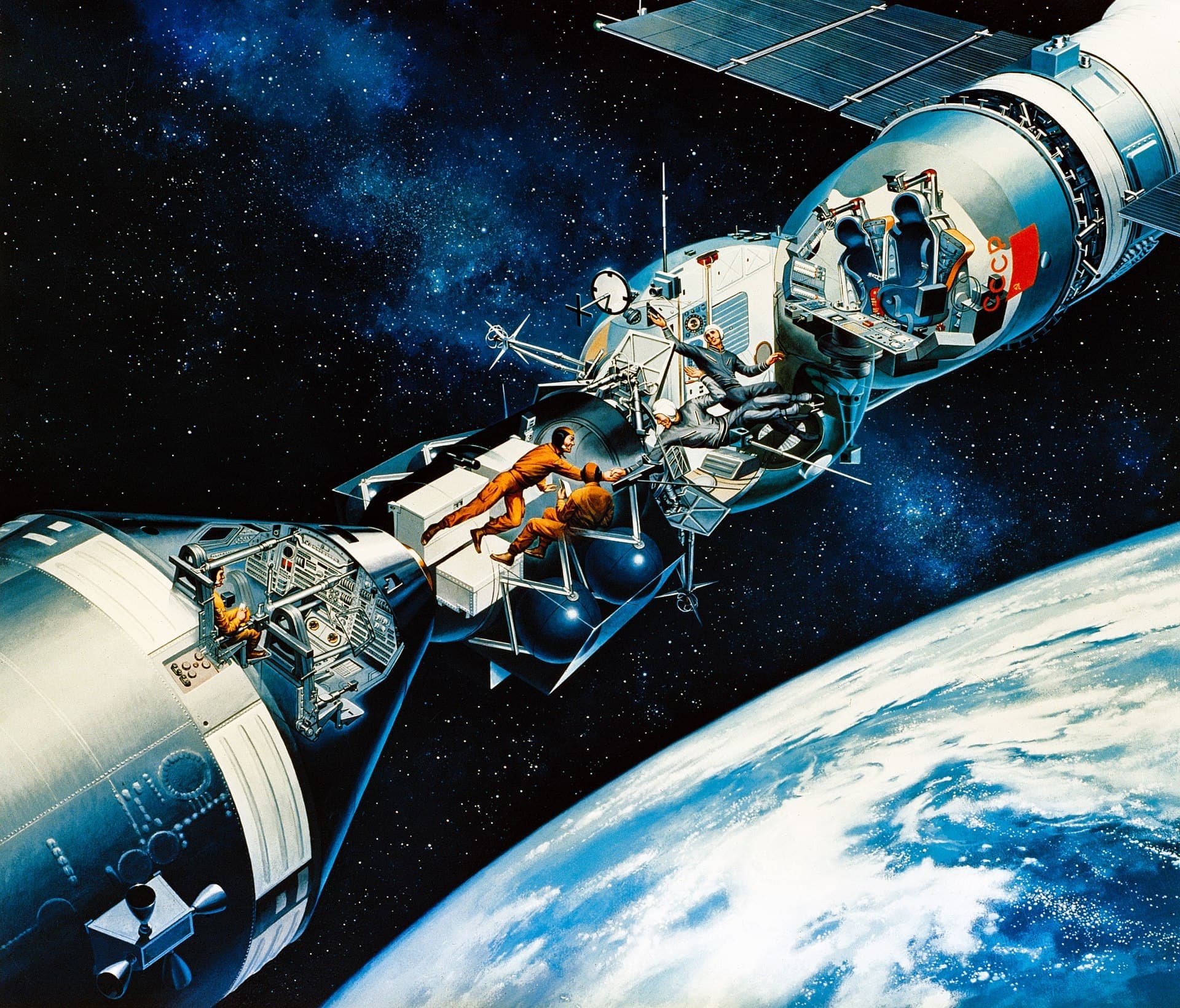
Apollo ran a low-pressure pure-oxygen cabin; Soyuz ran something much closer to sea-level air. A crew moving directly between them would have risked decompression sickness, so the mission carried a docking module that doubled as an airlock, letting each crew adjust before crossing.
The docking mechanism itself had to be redesigned. Existing systems were built around a probe on one vehicle and a drogue on the other, which requires agreeing in advance who is which. The two agencies instead developed an androgynous ring — identical on both craft, so either could take either role. That decision was diplomatic as much as mechanical, and it outlived the politics: androgynous docking is the idea the International Space Station still runs on.
They each learned the other's language
The crews trained together for three years, alternating between Houston and Star City outside Moscow, and the language arrangement they settled on is the detail that says the most about how carefully this was thought through. Each crew spoke the other's language.
Americans transmitted in Russian; Soviets transmitted in English. The reasoning is sound and slightly counter-intuitive: a person speaking their second language speaks slowly, chooses plain words and stays inside a vocabulary they have drilled, whereas a person speaking their first language relaxes into idiom and speed. Putting the burden on the speaker rather than the listener made every exchange more careful.
It is not a bad rule for meetings that have no orbital mechanics in them at all. The effort belongs with whoever is talking.
The day itself
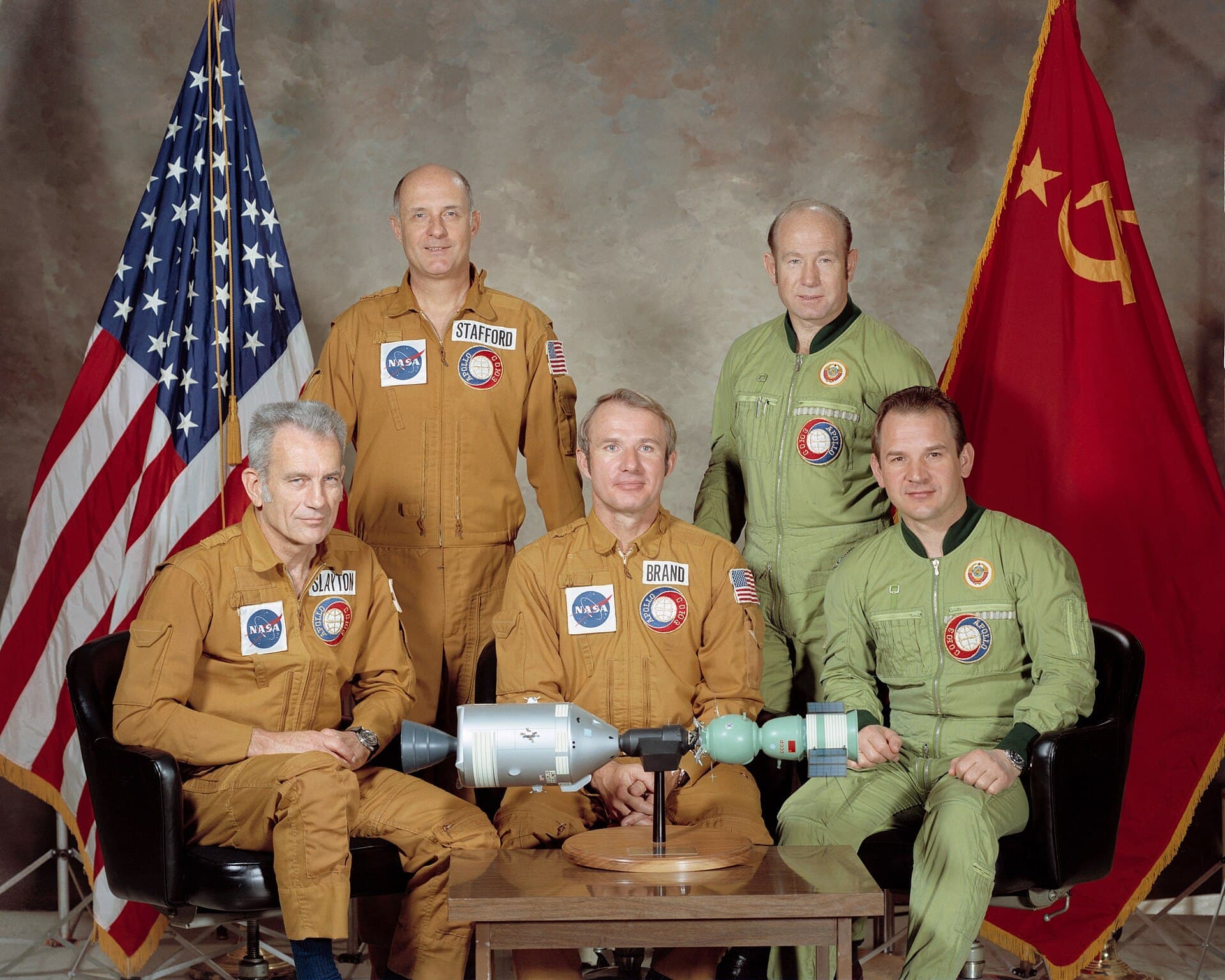
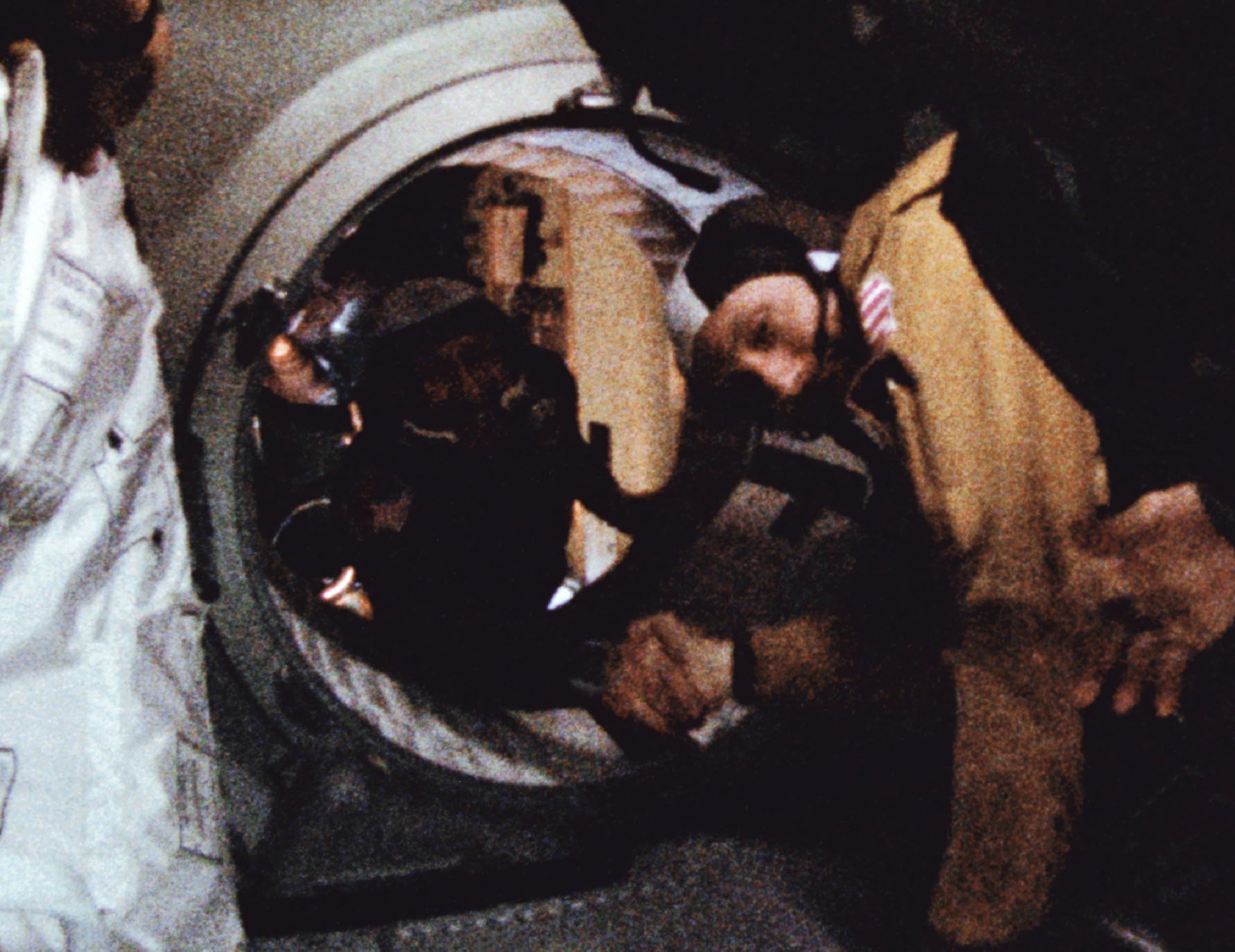
Both spacecraft launched on 15 July 1975, Soyuz first from Baikonur and Apollo about seven and a half hours later from Florida. They docked on 17 July. Thomas Stafford and Alexei Leonov shook hands through the open hatch, and the crews exchanged flags, gifts and a joint meal across two days of docked operations.
For the American side it was the last flight of an Apollo spacecraft, and the last time Americans flew in space until the first Space Shuttle mission in 1981. Deke Slayton, one of the original Mercury Seven, made his only spaceflight on it after years grounded by a heart condition.
Why the date could not slip
Every other meeting in this archive was scheduled around human availability. This one was scheduled around physics. Launch windows for a rendezvous are set by orbital geometry: the target's orbital plane, the rotation of the Earth beneath it, and how much propellant the chasing vehicle can spend fixing any mismatch. Miss the window and you wait for the geometry to come round again.
So the negotiation ran the other way from every summit. The date was computed, and the humans arranged themselves around it — years of joint training, shared documentation and language lessons, all aimed at a moment that had been fixed by arithmetic long before anyone knew whether the politics would hold.
The long tail
Détente did not last. Within five years the political relationship that produced ASTP had gone, and the follow-on joint missions being sketched in 1975 went with it. For most of the two decades that followed, the mission looked like a curiosity — an expensive handshake at the end of a programme that was being wound up anyway.
Then in 1995 an American Space Shuttle docked with the Russian station Mir, using a docking system descended from the one built for ASTP, and the joint operations resumed more or less where they had stopped. The International Space Station followed. The hardware, the procedures and a good deal of the institutional habit of working together came from a mission flown when the two countries had nothing else in common.
Which is the argument for holding the meeting even when nothing obvious comes of it. The point of ASTP was not the handshake. It was that two organisations who had never cooperated learned how, and wrote it down.
What people get wrong
The handshake is often described as the moment the Space Race ended. That is a tidy story rather than a historical judgement — the race is more usually dated to the 1969 lunar landing, and ASTP came six years and a full political thaw later. What can be said precisely is narrower and still remarkable: it was the first crewed spaceflight conducted jointly by the two countries, and the last flight of an Apollo spacecraft.
The date was computed, not agreed. Everyone else arranged themselves around it.