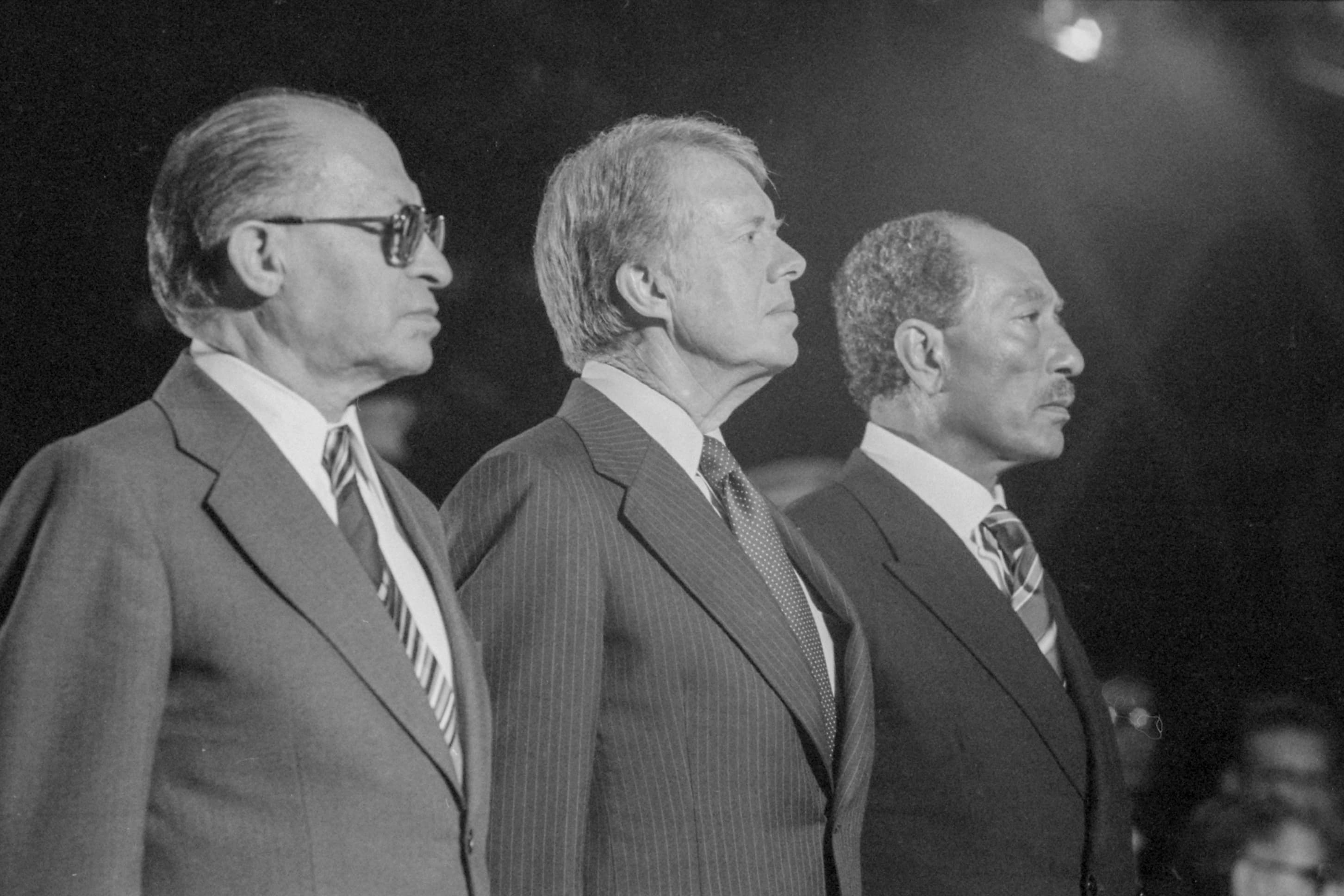
Egypt and Israel had fought four wars in twenty-five years. Sadat had already broken the taboo by flying to Jerusalem in 1977, and the follow-up talks had stalled completely. Carter's answer was to remove both leaders from their capitals, their press corps and their advisers' daily politics, and keep them there until something happened.
The venue was the method
Camp David is a rustic presidential retreat in the Maryland woods: cabins, footpaths, a small pool, no town nearby. Delegations were housed within a few hundred yards of one another. There was a single agreed press statement each day and nothing else — no briefings, no leaks to feed positions back home.
The informality was engineered. Cardigans instead of suits, meals in a shared lodge, bicycles on the paths. It removed most of the machinery by which a delegation performs toughness for an audience, because there was no audience.
The other deliberate choice was to announce no end date. An open clock means nobody can run it down waiting for the other side's plane.
Separating them
The direct meetings went badly. Sadat and Begin were personally ill-matched and the early sessions produced open hostility. After roughly the third day, Carter largely stopped putting them in a room together and worked instead as a shuttle between cabins, carrying successive drafts of a single text back and forth.
That single-text method — the mediator holds one document, each side comments on it privately, the mediator revises — meant neither party had to make a concession to the other's face. Something like twenty-three drafts went round before the end.
The talks nearly collapsed more than once. The most-repeated story, which comes from Carter's own account, is that Begin had his bags packed to leave and Carter defused it by handing him photographs of the three of them signed individually to each of Begin's grandchildren by name. It may have been decisive or it may have been one factor among several — but it is a fair illustration of what the isolation allowed a mediator to try.
What came out
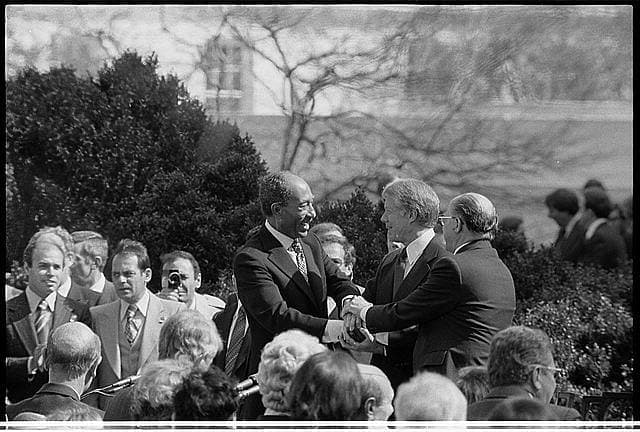
Two framework agreements, signed at the White House on 17 September. The first covered a bilateral Egypt–Israel peace: full withdrawal from Sinai, normal relations, freedom of passage. That one worked, and became the treaty signed in March 1979. The border has held since.
The second covered the West Bank and Gaza, and it did not work. It described a transitional autonomy arrangement in language vague enough for both sides to sign, and the process it envisaged never got started.
Sadat and Begin shared the Nobel Peace Prize that year. Sadat was assassinated three years later, in part for what he signed there.
What people get wrong
Camp David is often remembered as a comprehensive Middle East peace. It was not — the second framework, on the Palestinian territories, produced nothing. It is also commonly assumed Carter shared the Nobel: the 1978 prize went to Begin and Sadat only. Carter received one in 2002, for other work.
After three days he stopped putting them in the same room and started carrying drafts between cabins.