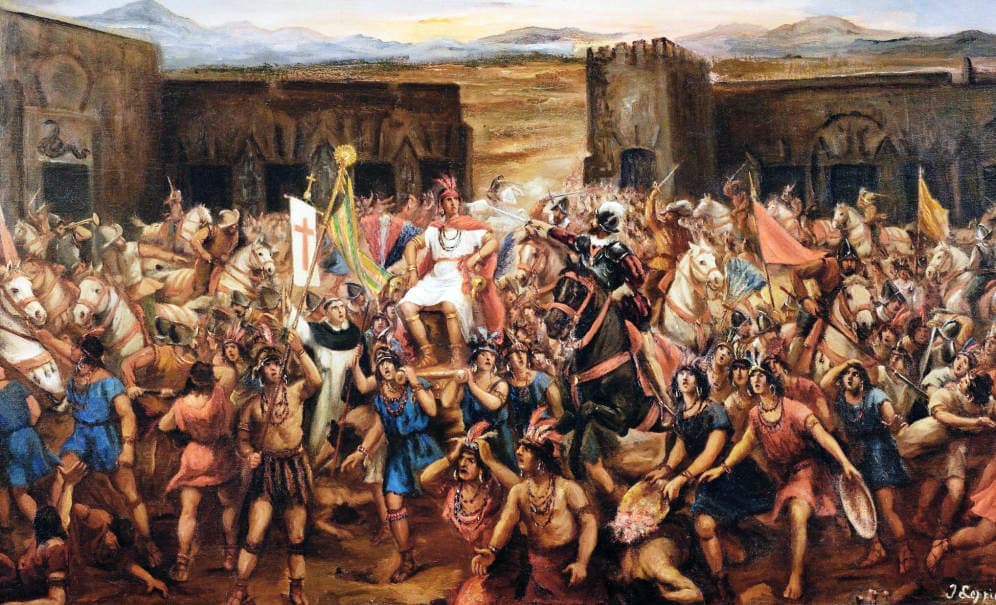
Atahualpa had just won a civil war for the Inca throne and was camped with an army outside Cajamarca. Pizarro, with 168 men, occupied the empty town and sent an invitation to meet. Atahualpa accepted, and said he would come the following day.
The venue was chosen by the weaker party
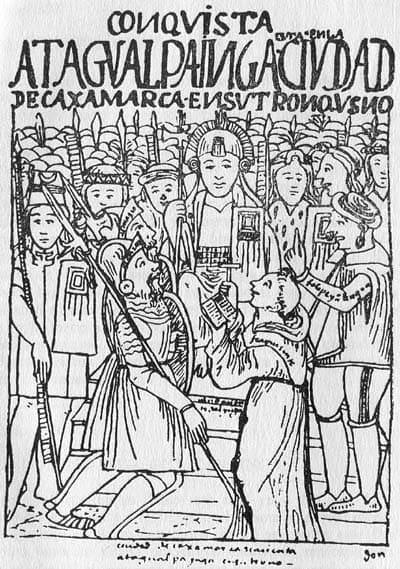
Cajamarca's central square was enclosed on three sides by long buildings with wide doorways. Pizarro put his cavalry and most of his men inside them, out of sight, with orders not to move until a signal.
Atahualpa came in on a litter with several thousand attendants, in ceremonial dress, without a fighting force — he was arriving for a reception, and everything about how he arrived says so. The one meaningful advantage the Spanish had was that they knew what kind of meeting it was and he did not.
The ninety minutes
A friar, Vicente de Valverde, approached with an interpreter and a breviary and delivered a formal demand that Atahualpa accept Christianity and Spanish sovereignty. Atahualpa examined the book, asked how it spoke, and dropped it.
That was the signal. The Spanish opened fire with two small cannon and charged from the buildings on horseback. The square was walled, the crowd could not disperse, and the killing went on until dark. Thousands of Atahualpa's people were killed; the Spanish lost nobody. Atahualpa was taken alive on purpose.
The ransom
Held prisoner, Atahualpa offered to fill a room once with gold and twice with silver in exchange for his release. It was delivered over eight months, from temples and palaces across the empire, and melted down.
He was executed anyway, in July 1533, on charges assembled after the fact. The Inca state did not survive the decade.
What people get wrong
It is often told as 168 men defeating an empire, as though the numbers alone were the story. They are not. Atahualpa had just fought a civil war against his brother that had split the empire, and the Spanish spent the following years fighting with one Andean faction against another; smallpox had already moved down the continent ahead of them and killed the previous emperor. Cajamarca was a massacre of a ceremonial party inside a walled square, not a battle, and what followed it was a coalition war rather than a conquest by 168 people.
He arrived on a litter, in ceremonial dress, without a fighting force. Everything about how he came says what he thought the meeting was.