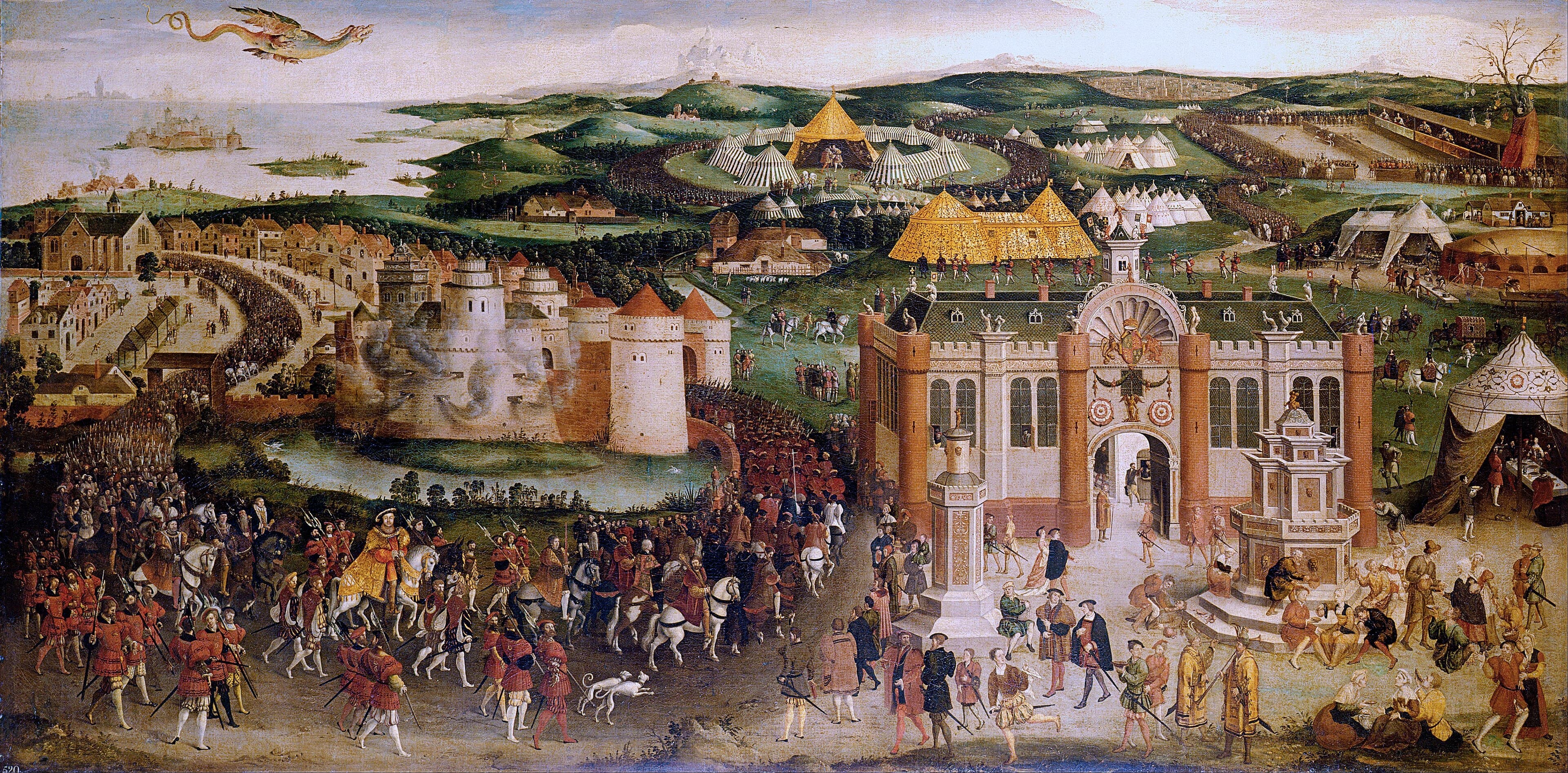
The two young kings of England and France agreed to meet in neutral ground between the English-held town of Guînes and French Ardres. What they built there took months of preparation, consumed an enormous share of two annual revenues, and produced nothing either side could point to afterwards.
The production
Henry's party built a temporary palace roughly a hundred metres square, with brick foundations, canvas walls painted to look like stone, and real glass windows — the largest such structure anyone had attempted. There were fountains running wine, hundreds of tents in cloth of gold, and a tournament ground with a gallery.
Both delegations numbered in the thousands. The catering figures that survive are absurd: tens of thousands of gallons of wine, thousands of sheep. The English exchequer felt it for years.
None of this was decoration in the modern sense. Magnificence was the medium of the message; a king who could stage this could presumably field an army that matched it. The event was the argument.
What actually happened
There were tournaments, masques, banquets, and an archery display in which Henry did well. The two kings wrestled at one point, and Francis won, which was noticed.
There was almost no negotiation. The parties present were nominally there to affirm a treaty of friendship that already existed, and the substantive talking that mattered was happening elsewhere: Henry met the Holy Roman Emperor Charles V both before and after — quietly, in Kent and in Gravelines — and it was those meetings that shaped what England did next.
By 1522 England was at war with France, on Charles's side.
Why it is still worth studying
As a summit it failed completely. As a piece of staging it worked so well that it named itself — five hundred years later the phrase Field of the Cloth of Gold still evokes the specific idea of ruinous ceremonial excess.
The recurring lesson is unglamorous. The meeting everyone photographs is rarely the meeting that decides anything. The real business was done in two small unpublicised gatherings on either side of the spectacle, and the spectacle existed partly to occupy attention while they happened.
What people get wrong
It is often described as a peace summit that broke down. It was not really a negotiation at all — the treaty it celebrated had been agreed two years earlier, and no new terms were signed at Balinghem. The wrestling match is well attested in later accounts but not in the official records, so treat the detail as a good story rather than a documented fact.
The meeting everyone remembers decided nothing. The two quiet ones on either side of it decided everything.