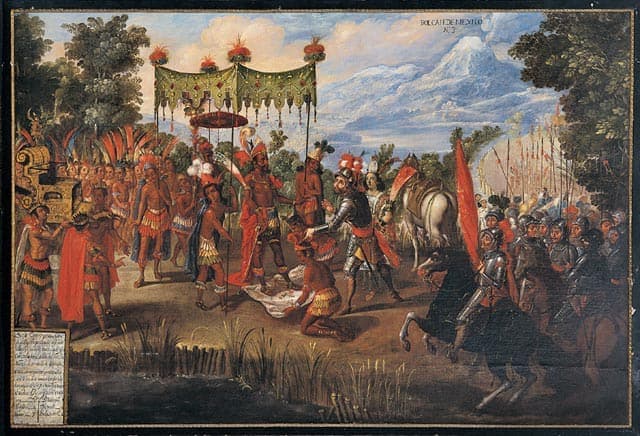
Cortés had landed at Veracruz in April, burned his ships, fought and then allied with Tlaxcala, and marched inland with an army that was mostly not Spanish. Moctezuma had been tracking the party by runner for months and had sent embassies, gifts and, by some accounts, instructions to turn back. In November he came out onto the causeway to receive them.
Nobody could hear the other directly
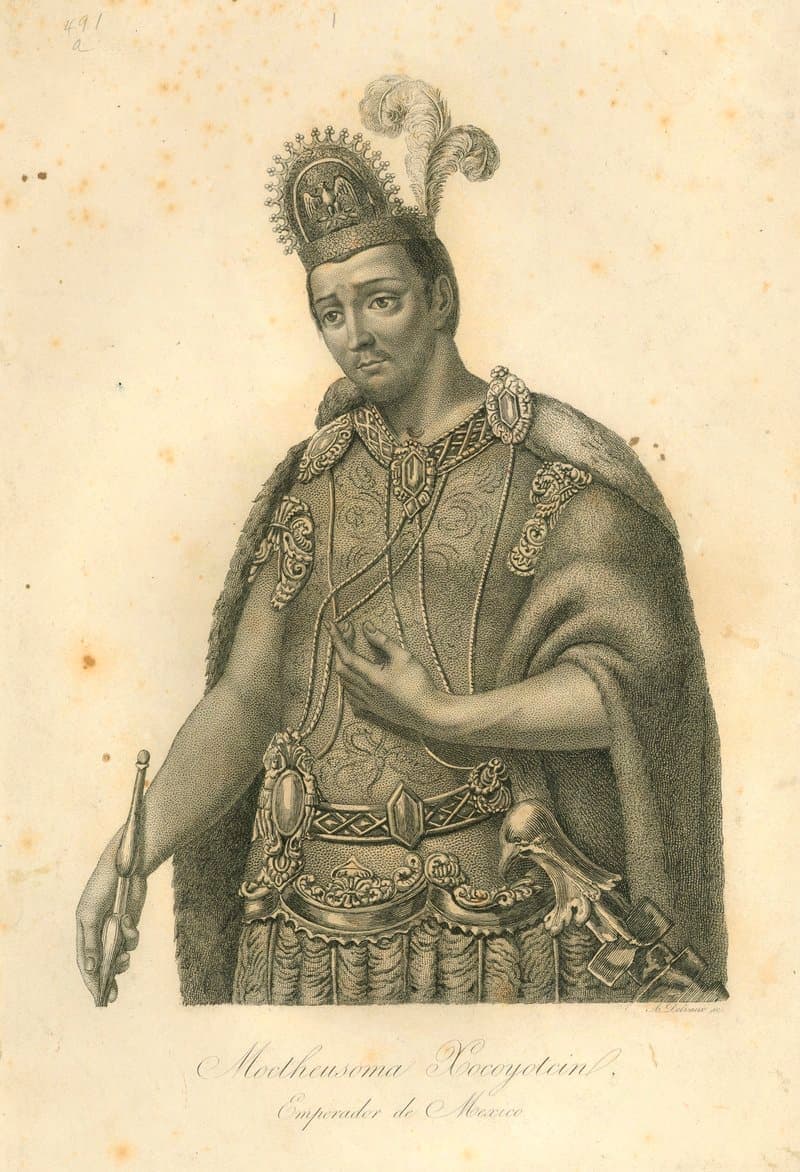
Cortés spoke Spanish. Jerónimo de Aguilar, a shipwrecked priest who had spent eight years among the Maya, turned it into Yucatec Maya. Malintzin — a Nahua woman given to the Spanish as a slave, later called Doña Marina — turned the Maya into Nahuatl for Moctezuma, and back again.
Two hops, in both directions, on the most consequential conversation either state would ever have. Whatever was actually said arrived at the other end having passed through two people with their own positions, and only one of the four principals could hear both ends of the chain. Malintzin is the single most important figure in the room and the one about whom the records are least interested.
What was said
Cortés' own letters to Charles V report a speech in which Moctezuma effectively hands over his kingdom, acknowledging the Spanish as the returning heirs of an ancient ruler. That letter was written by a man who needed to justify an expedition he had launched in defiance of his own governor, to a king who could have had him arrested.
The other main account, by Bernal Díaz del Castillo, was written decades later by a participant in his seventies who was, among other things, annoyed at how much credit Cortés had taken. Nahua accounts collected later, notably in the Florentine Codex, describe the meeting quite differently.
The Spanish were housed in a palace in the city. Within a week they had taken Moctezuma into custody inside his own capital, and within two years Tenochtitlan was destroyed.
The alliance nobody mentions
The force that took Tenochtitlan was overwhelmingly indigenous. Tlaxcala, which had been fighting the Mexica for generations, supplied the great bulk of the army, and the campaign is better understood as a regional war in which a small Spanish contingent joined the losing side and changed its odds.
Smallpox, arriving in 1520, did more than either army. The meeting on the causeway did not decide the outcome; it opened the door for a coalition that already existed.
What people get wrong
The story that the Mexica took Cortés for the returning god Quetzalcoatl is very weakly supported. It appears in Spanish-supervised sources written after the conquest and is largely absent from the earliest indigenous material — it is far more useful as an explanation composed afterwards than as a description of what anyone believed at the time. "Moctezuma handed over his empire" comes from a letter with an obvious motive. And Cortés did not burn his ships in the romantic sense; he ran most of them aground and stripped them, which is a supply decision rather than a gesture.
Two hops of translation, in both directions, and only one person in the chain could hear both ends.