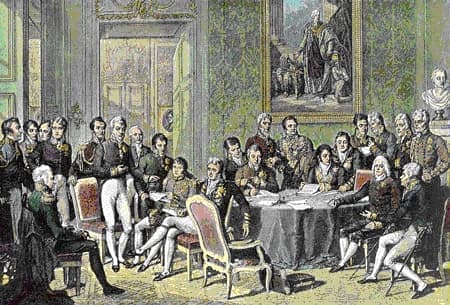
Napoleon had been beaten and exiled to Elba, and the borders of Europe were whatever the armies had last left them as. Someone had to decide what the continent looked like now. What followed was less a conference than a nine-month social season with a settlement attached.
There was no meeting
The Congress of Vienna never held a formal plenary session of all its participants. Not once. There was no opening ceremony of the whole body, no agenda circulated to the membership, no chamber in which everyone sat down together.
What existed instead was a set of overlapping committees, and above them a small group — Austria, Britain, Prussia and Russia, joined before long by France — who took the decisions that mattered. Everyone else was in Vienna to be informed, to lobby, and to sign at the end. The famous Isabey engraving that illustrates this page shows a committee at work, not a plenary; the image of a great round table of nations is a later invention.
This was not disorganisation. It was the design. Metternich, who ran it, understood that a formal session of a hundred delegations would produce speeches rather than agreement, and that anything decided in public would be impossible to trade away in private.
The business was done at parties
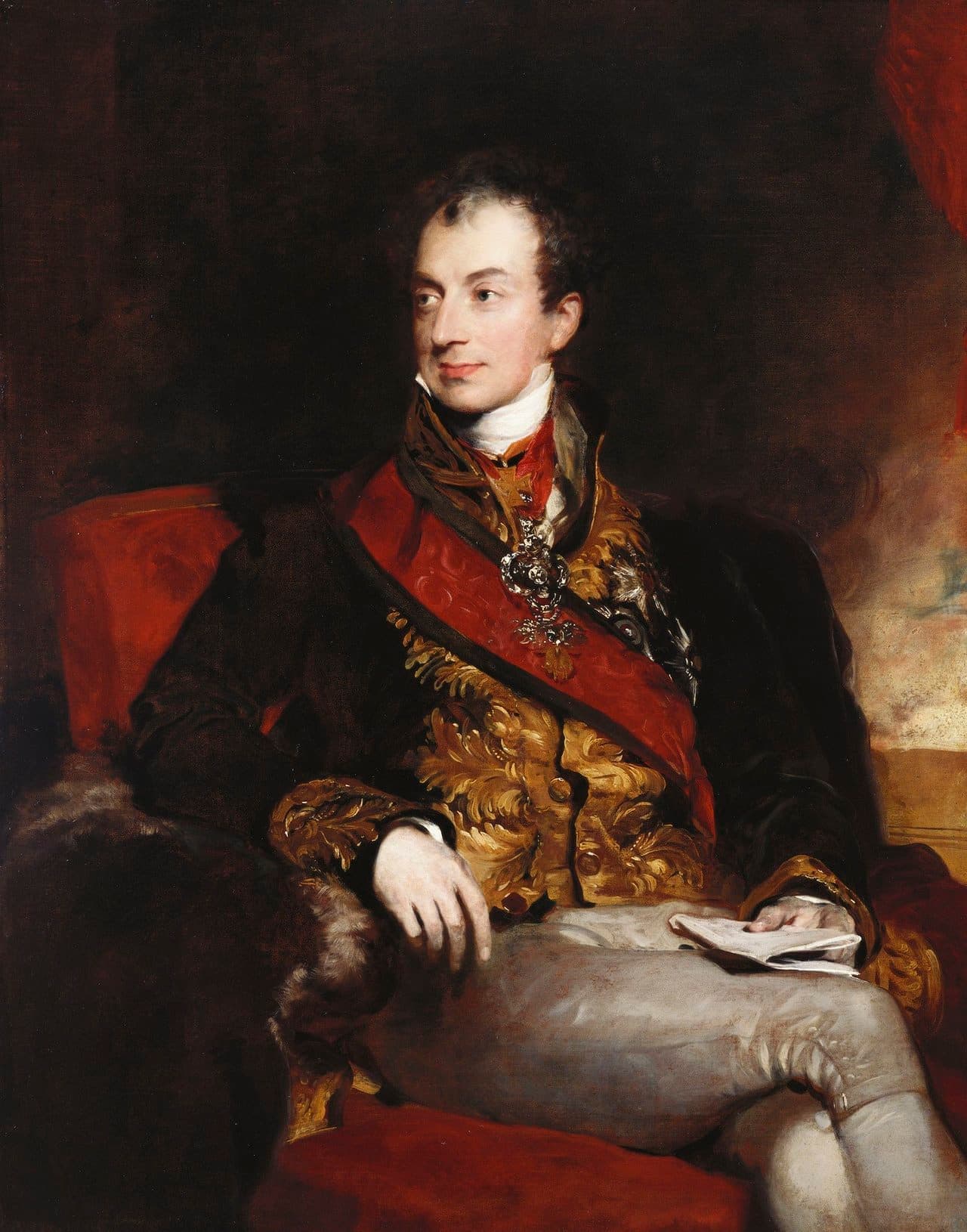
Vienna spent that winter hosting an almost continuous entertainment: balls, hunts, concerts, tableaux, receptions. The Austrian treasury took a serious hit paying for it. It is the origin of the line usually credited to the Prince de Ligne — that the congress does not proceed, it dances.
The entertainment was the working method. A ball put a Prussian minister and a Russian one in the same room for six hours with no minutes being taken and no positions being committed to. Sovereigns who could not be seen to call on one another could meet by accident at a concert. The salons of a handful of Viennese hostesses did more scheduling work than any secretariat.
It also meant the Austrian secret police read a great deal of correspondence and listened at a great many doors, and Metternich started most days better briefed than the people he was negotiating with.
France talked its way back in
France arrived as the defeated power, expected to accept terms rather than set them. Talleyrand, representing a restored monarchy that had been on the throne for months, worked out that his only opening was procedural: he argued loudly for the rights of the smaller states to be heard.
The four great powers had no intention of letting the small states decide anything, but they could not easily say so in public. Rather than have Talleyrand make a scandal of it, they brought him into the inner group to keep him quiet. Within weeks France was one of the powers deciding the settlement it had been summoned to accept.
Then Napoleon came back
In March 1815, with the congress still sitting, news arrived that Napoleon had left Elba and landed in France. The delegates were still in Vienna arguing about Saxony and Poland while he marched on Paris and the restored king fled.
The congress did not adjourn. It declared Napoleon an outlaw, kept working, and signed its Final Act on 9 June 1815 — nine days before Waterloo. The settlement it produced was in force before the battle that made it durable had been fought.
That settlement held better than anyone had reason to expect. There was no general European war for ninety-nine years, which for a continent with that record is close to remarkable. Whether the credit belongs to the terms or to the exhaustion of everyone who signed them is an argument that has never really finished.
What people get wrong
“The Congress of Vienna” names a period and a place rather than an event. It had no fixed membership, no formal sessions, no chairman in any procedural sense, and no single moment at which it can be said to have convened. Its Final Act was a compilation — the separate agreements reached over nine months, gathered into one document and signed at the end. Anyone imagining a conference table with nameplates is imagining something that did not happen.
A ball put two ministers in the same room for six hours with nobody taking minutes. That was the mechanism.