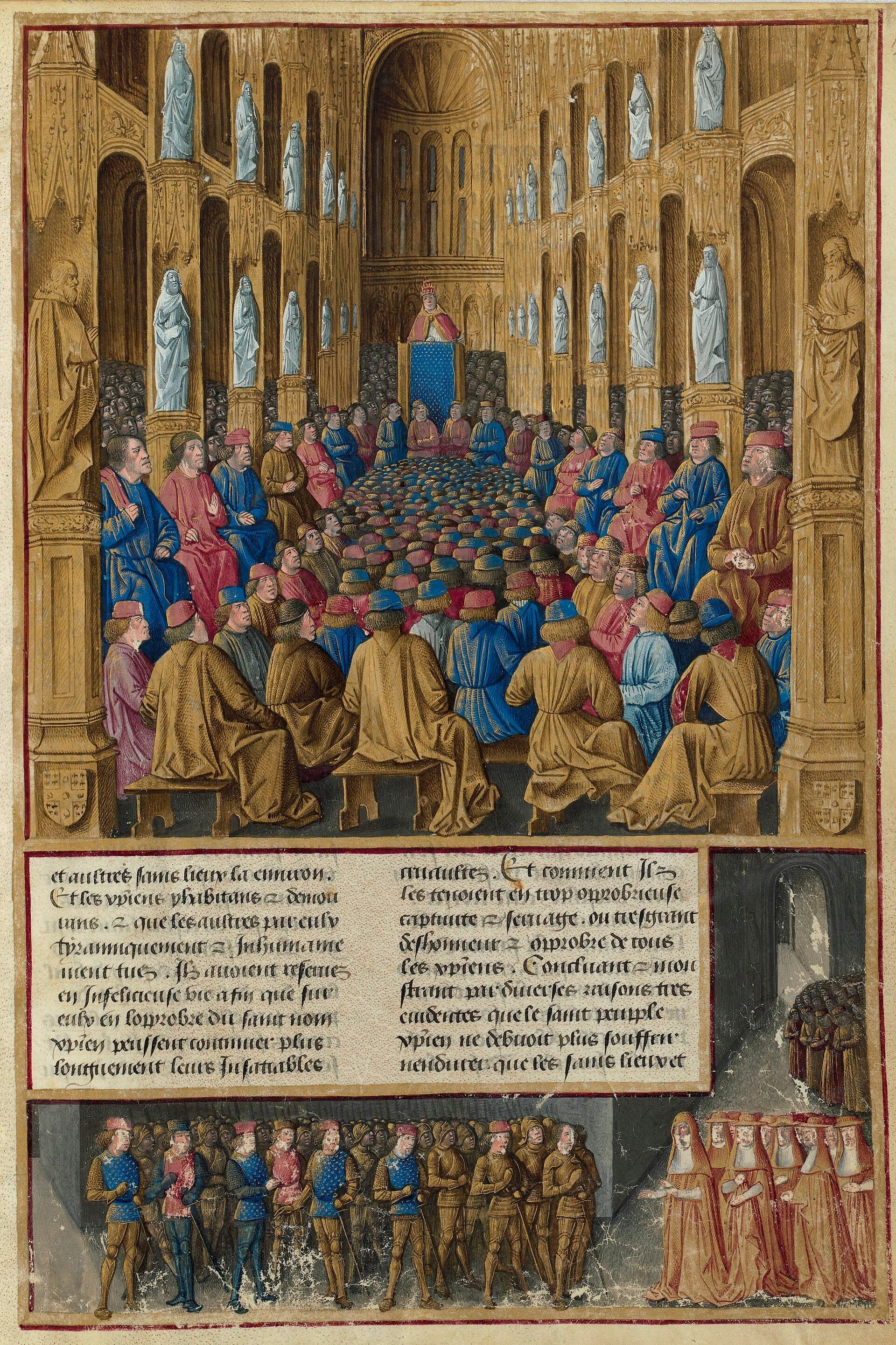
The council itself was ordinary church business — bishops, canons, disputes about clerical discipline. On the last day Urban II announced that he would preach in the open air, because what he had to say would not fit in the cathedral, and neither would the crowd that had gathered to hear it.
The ask
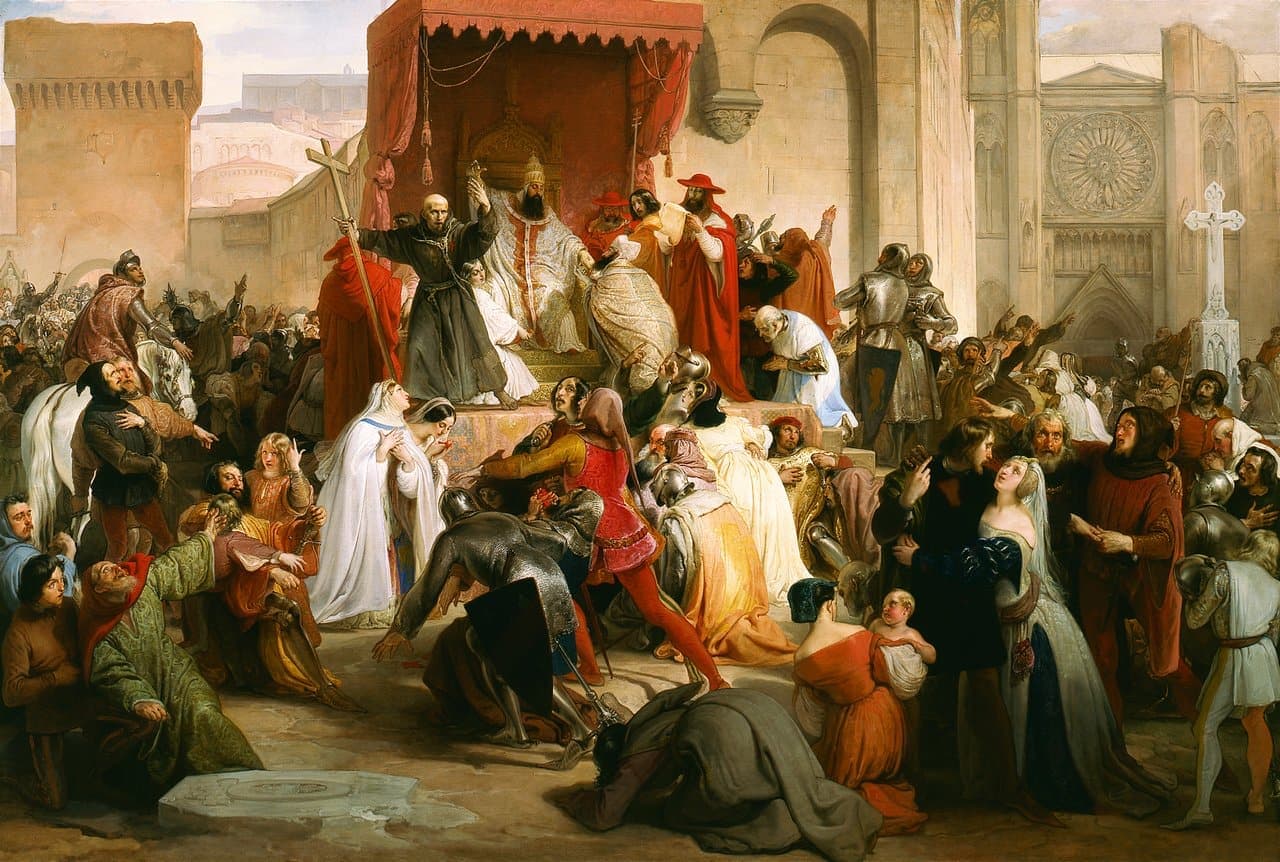
The Byzantine emperor Alexios Komnenos had sent envoys asking for military help against the Seljuk Turks — a request for mercenaries, essentially, of the sort that had been made before. What Urban announced at Clermont was very much larger than what had been asked for: an armed pilgrimage to Jerusalem, open to anyone, with the remission of sins for those who went.
The response was immediate and much bigger than anticipated. Contemporary accounts describe the crowd interrupting with shouts of Deus vult — God wills it. Within months preachers were carrying the message across France and the Rhineland, and the response included large numbers of people with no military use whatsoever, which was not the plan.
Nobody knows what he said
Five versions of the sermon survive. They disagree about the content, the emphasis and the arguments used, and every one of them was written down after 1099 — after Jerusalem had fallen and the enterprise had become, to the people recording it, evidently blessed.
One of the five was written by a man who was present. The others were not. All of them were composed by people who knew the ending and were, consciously or not, writing a speech that would explain it. What Urban actually said to that crowd in November 1095 is not recoverable.
The deadline
The one concrete instrument was a date. Departure was set for the Feast of the Assumption — 15 August 1096 — roughly nine months out, chosen to allow a harvest to be gathered and affairs to be settled.
It mostly failed as a deadline. Several large and largely unarmed groups set off months early, ran out of food, and caused a great deal of destruction on the way east, including massacres of Jewish communities in the Rhineland that had nothing to do with anything Urban had asked for. The organised armies left roughly on time. Jerusalem fell in July 1099.
It is a bleak illustration of a familiar problem: announce something to a large audience without controlling how it propagates, and the version that reaches most people will not be the one you delivered.
What people get wrong
The famous phrases are unreliable. Deus vult appears in some accounts and not others. The eloquent passages quoted in popular histories come from chronicles written years after the fact by authors reconstructing what must have been said to produce the result they had witnessed. Quoting Urban's Clermont sermon is quoting a later writer's reconstruction, and the versions do not agree with one another.
Five people wrote down the speech. All of them wrote it after they knew how the story ended.