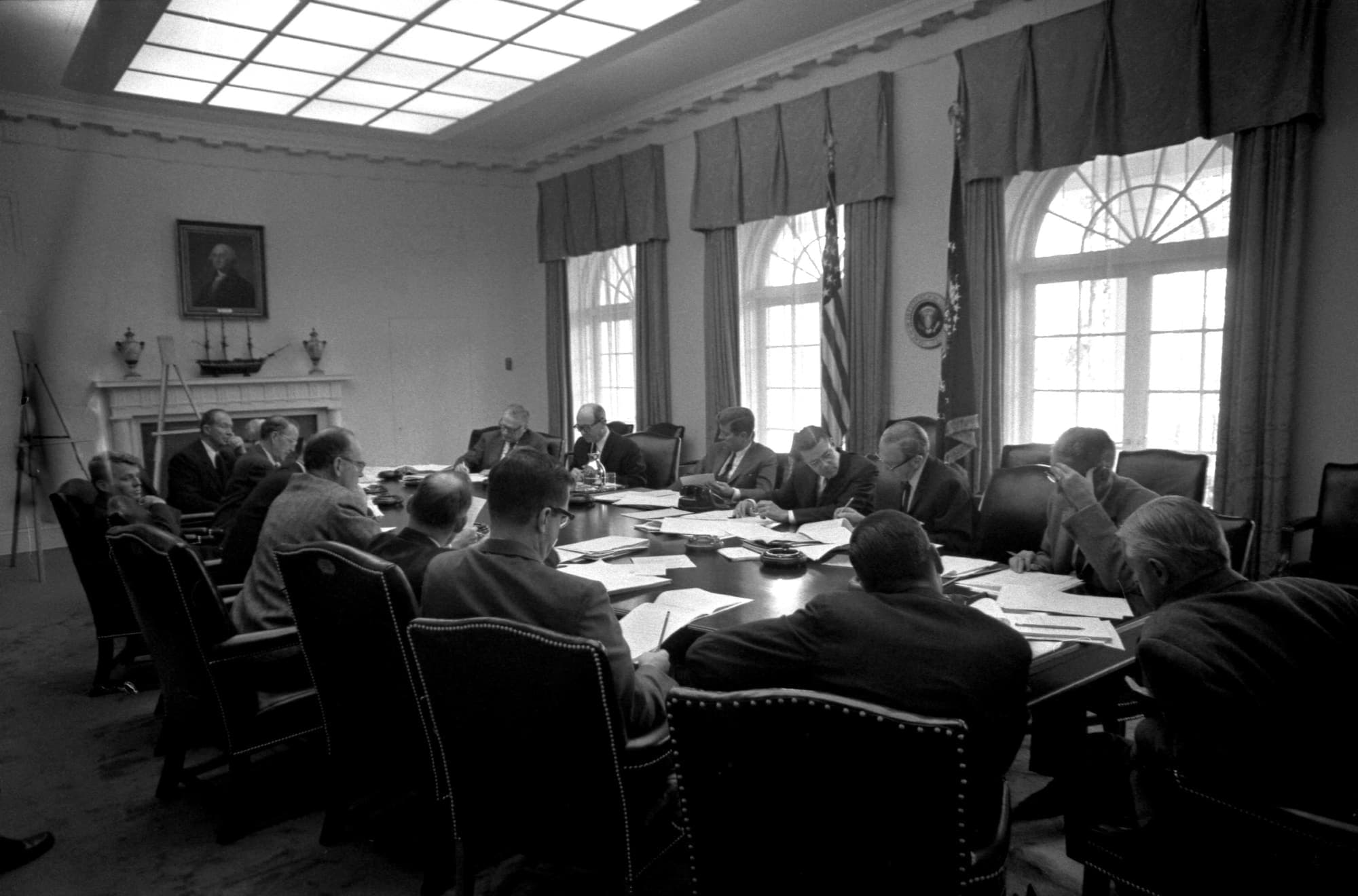
On 16 October Kennedy was shown U-2 photographs of Soviet medium-range missile sites under construction in Cuba. He assembled an ad-hoc group of officials — the Executive Committee of the National Security Council, ExComm — and met with them, sometimes several times a day, for the next twelve days.
The chairman leaves the room
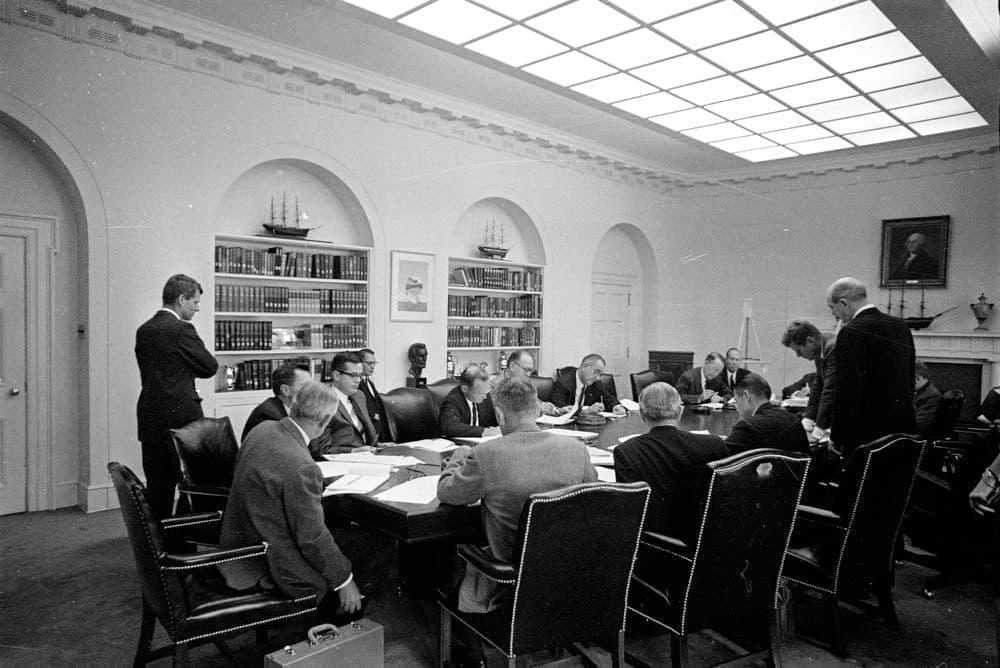
Kennedy had watched the Bay of Pigs go wrong the year before partly because nobody had contradicted the plan in front of him. This time he deliberately absented himself from some sessions, on the theory that a group argues more honestly when the president is not sitting at the head of the table waiting to hear what it concludes.
The recordings bear that out. The sessions he is not in are noticeably franker, and positions move in them.
The composition was informal on purpose. It included people with no relevant office — his brother Robert, the attorney general, and Dean Acheson, a private citizen — because what he wanted was argument rather than a chain of command.
What the tapes show
The first day's discussion is overwhelmingly in favour of an air strike, including from people later remembered as doves. The move towards a naval blockade — called a quarantine, because a blockade is legally an act of war — happens over several days of argument, not in a flash of insight.
The Joint Chiefs pressed hard for invasion throughout, and there is a well-known exchange in which General LeMay tells the president that the blockade is appeasement, comparable to Munich. Kennedy overruled them.
Because the participants did not know they were being recorded, the tapes have none of the self-presentation that memoirs have. People change their minds mid-sentence, misremember facts, and say things they later denied saying.
How it ended
Publicly: the Soviets withdrew the missiles in exchange for an American pledge not to invade Cuba. Privately: Robert Kennedy told the Soviet ambassador that American Jupiter missiles would come out of Turkey within a few months, provided nobody said so. They did, and for decades nobody said so.
The concession was kept out of the record deliberately, and several participants spent years publicly denying a trade had happened. It stayed hidden until the 1980s.
What nobody in that room knew was how close it actually was — that tactical nuclear weapons were already on Cuba, and that a Soviet submarine officer named Vasili Arkhipov had refused to authorise a nuclear torpedo during the blockade.
What people get wrong
Kennedy did not stare down Khrushchev and win outright. The public deal was paired with a secret one — the Jupiters came out of Turkey — that was concealed at the time and denied afterwards, and the concealment shaped a generation of American thinking about how crises are won. The famous line "we're eyeball to eyeball, and I think the other fellow just blinked" is Dean Rusk's, said on 24 October about ships turning around, and it has been attached to the wrong moment ever since.
He left the room on purpose. A group argues more honestly when the president is not waiting to hear what it decides.