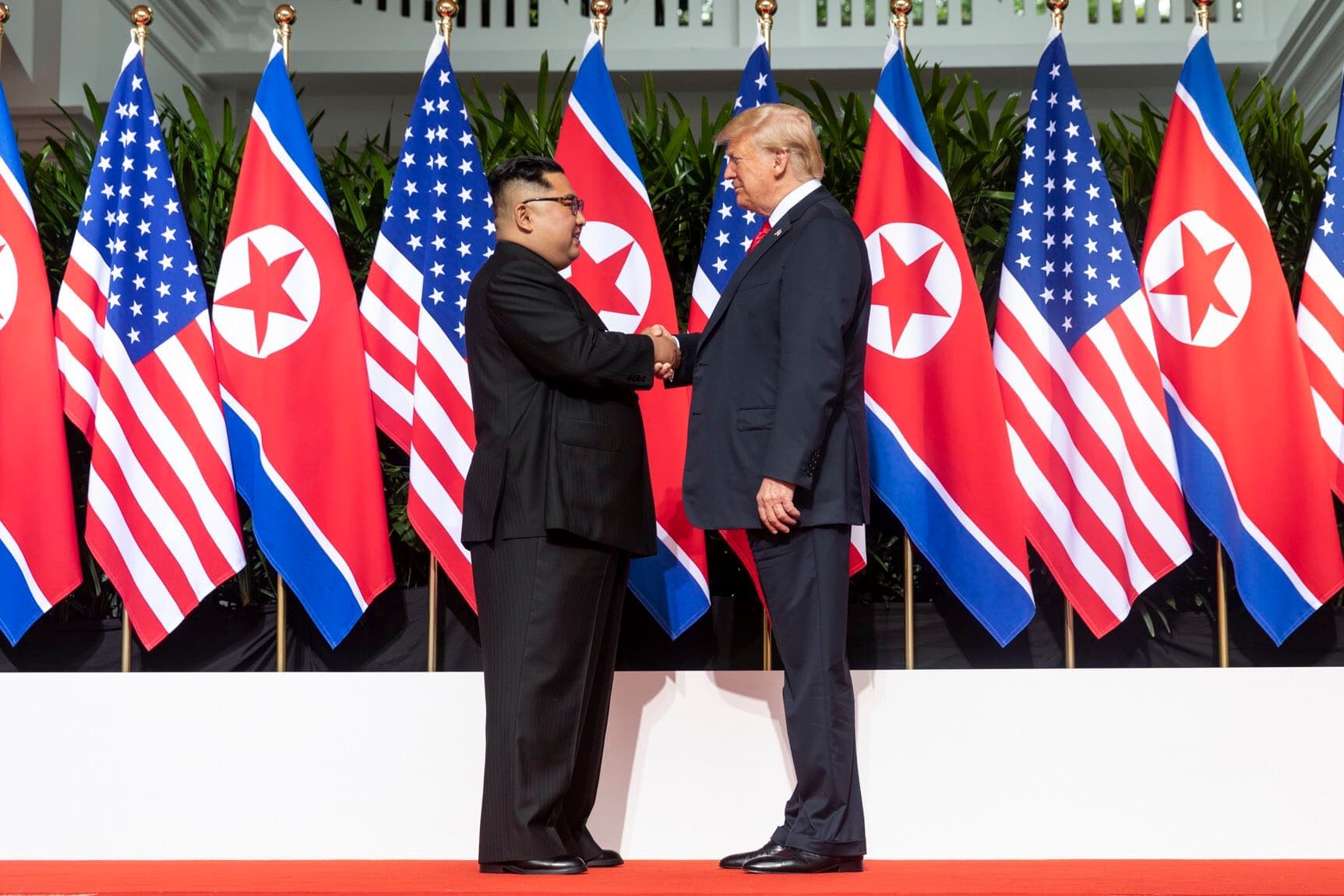
No sitting American president had ever met a North Korean leader. The meeting that finally happened was arranged, announced, publicly cancelled and then held anyway inside about three months — a pace that had more in common with a news cycle than with diplomacy.
Choosing somewhere that worked for both
Venue selection is usually the least interesting part of a summit. Here it was most of the problem. The site had to be somewhere North Korea's leader could reach — his aircraft's range was a real constraint — somewhere both governments considered neutral, and somewhere capable of securing two delegations that regarded each other as hostile.
Singapore satisfied all three. It had diplomatic relations with both, a police force accustomed to large protective operations, and an island resort that could be closed off entirely. It also absorbed a substantial share of the cost, reported at around sixteen million Singapore dollars, on the reasoning that hosting was worth more than it spent.
Cancelled in public
On 24 May 2018, with preparations well advanced, the American side cancelled — not through diplomatic channels but in an open letter, released to the press, addressed to Kim Jong-un and citing hostility in recent North Korean statements.
The North Korean response was conciliatory and also public. Within a day officials on both sides were signalling that the meeting might be back on; within a week it was. The summit went ahead on the original date, nineteen days after being called off.
It is a genuinely novel way to run a schedule. Both the cancellation and the reinstatement were performed for an audience, and the negotiation over whether the meeting would occur was itself conducted through press releases.
What was signed
The two men met alone with interpreters, then in larger groups, and signed a joint statement of four points: to establish new relations, to build a lasting peace on the peninsula, to work toward complete denuclearisation of the Korean Peninsula, and to recover the remains of prisoners of war and missing in action.
The document is about a page. It contains no definition of denuclearisation, no timetable, no sequencing, no verification provisions and no reference to the inspections regime that had governed previous agreements. The phrase “of the Korean Peninsula” is not the same commitment as North Korean disarmament, and has historically been understood by Pyongyang to include the American security guarantee to the South.
Alongside it, the United States announced a suspension of joint military exercises with South Korea — a substantive concession that was not in the signed text and had not, by several accounts, been cleared with Seoul in advance.
What happened next
A second summit in Hanoi in February 2019 broke up early without agreement. A brief meeting at the demilitarised zone followed that June, making Trump the first sitting president to step into North Korea. Working-level talks in Stockholm later that year collapsed.
North Korea's nuclear and missile programmes continued. Judged by its stated objective, the Singapore process did not achieve it.
What it did establish is harder to score. Two governments with no relations and a recent history of open threats demonstrated that their leaders could sit in a room. Whether a meeting that produces a photograph and a page of intentions is worth holding is a real question, and the answer here is genuinely contested — which is why it is the last entry in this archive rather than a settled one.
What people get wrong
The Singapore joint statement is frequently described as a denuclearisation agreement. It is not an agreement in the treaty sense and it does not define what it commits either party to. Its language — working toward complete denuclearisation of the Korean Peninsula — restates a formula both governments had used before, without the definitions, deadlines or verification that would make it operative. Reading it as a disarmament deal that was later broken misdescribes what was on the paper.
Both the cancellation and the reinstatement were press releases. The scheduling was the news story.