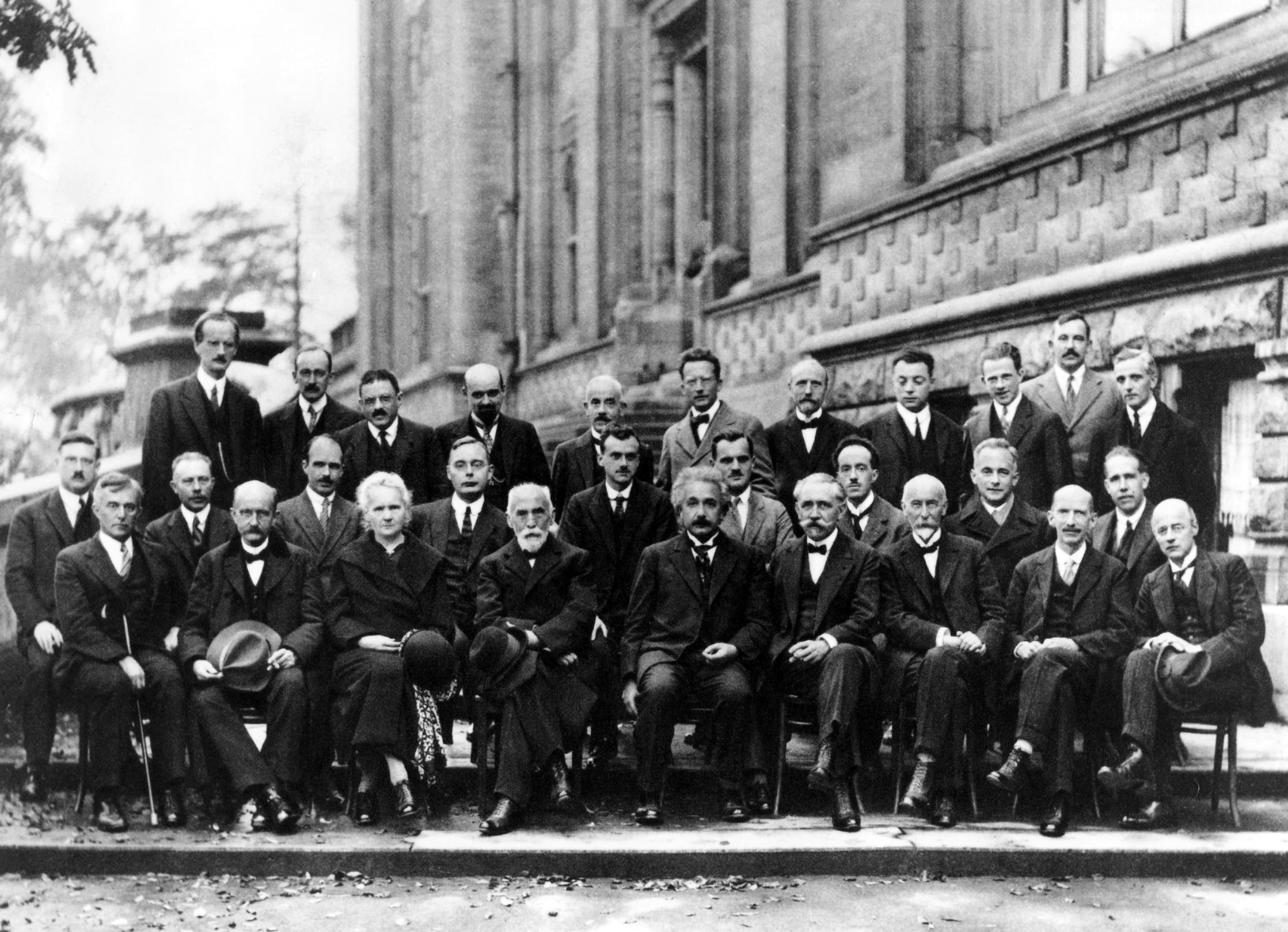
By the autumn of 1927, quantum mechanics worked. That was the problem. The mathematics predicted experimental results with uncomfortable precision, and nobody could agree on what it said about the world. So twenty-nine physicists were invited to Brussels to argue it out in person.
Why anyone bothered getting on a train
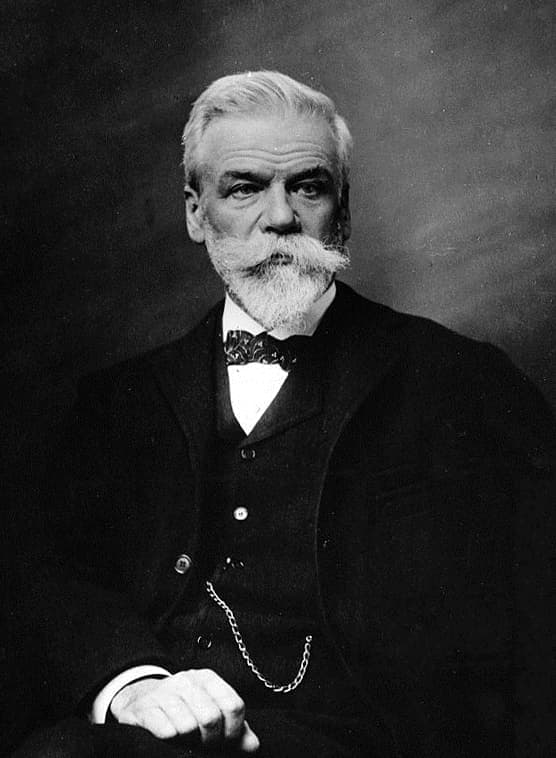
The Solvay conferences existed because Ernest Solvay, a Belgian industrial chemist, decided physics needed a room. He had made a fortune on a process for manufacturing soda ash, and from 1911 he endowed a series of invitation-only meetings in Brussels on whatever question in physics looked most unsettled.
Solvay had left school early and taught himself chemistry. He had no university position and no scientific reputation to protect, which is possibly why he was willing to spend money gathering people who disagreed with each other rather than people who would flatter him. He set the format: a small invited list, a single unsettled subject, and days long enough for an argument to develop.
By 1927 the unsettled subject was quantum mechanics. Werner Heisenberg's matrix mechanics and Erwin Schrödinger's wave equation had both arrived within the previous two years, they gave the same answers by very different routes, and the physical picture behind them was contested. The fifth conference took “Electrons and Photons” as its subject and put the principal antagonists in one building for six days.
What was actually broken
It is worth being precise about the problem, because “nobody understood quantum mechanics” undersells it. Everybody could use quantum mechanics. It was extremely good. The equations returned spectral lines that matched what came out of laboratories, to more decimal places than anyone had managed before.
The trouble was what sat underneath. Max Born had proposed in 1926 that the wave in Schrödinger's equation was not a physical thing but a distribution of probabilities — the electron did not have a position that the wave described, it had odds. Heisenberg had shown in early 1927 that position and momentum could not both be pinned down. And barely a month before Brussels, at a conference at Como, Bohr had set out complementarity: the idea that wave and particle descriptions were both necessary and could never be applied at once.
So the delegates arrived with a theory that worked perfectly and a set of brand-new claims about reality that were, at that point, weeks old. Solvay was the first occasion on which the people who had made those claims and the people who mistrusted them were in the same room with time to spare.
The argument that actually happened
The conference is remembered for the exchanges between Albert Einstein and Niels Bohr over whether quantum mechanics was a complete description of nature. Einstein's method was to construct thought experiments — idealised arrangements of slits, shutters and screens — that appeared to let you measure more than the theory permitted.
Accounts from other attendees describe a rhythm to it: Einstein would produce a challenge, and Bohr, often with help from colleagues over the course of the day, would return an answer showing the proposed setup defeated itself. Einstein never conceded the underlying point. He accepted the mathematics and rejected the idea that it was the final word.
What consolidated at Brussels was not a proof but a working consensus — the interpretation that became known as the Copenhagen view, which most physicists then used for decades without needing to resolve what Einstein was objecting to.
The photograph
On one of the days the delegates assembled outside for a group portrait taken by Benjamin Couprie: three rows, twenty-nine people, formal dress. Lorentz sits centre front as chair. Marie Curie sits beside him, the only woman present and the only person there holding Nobel Prizes in two different sciences.
Seventeen of the twenty-nine had won or would win a Nobel Prize. That density is why the image circulates today with captions calling it the most intelligent photograph ever taken — an internet-era nickname rather than a historical title, but not an unreasonable one.
How you convened a summit in 1927
There was no mechanism for asking twenty-nine people when they were free. Invitations went out by post from the institute's scientific committee. Confirmations came back by post. Travel across Europe meant rail timetables and, for several attendees, several days in transit each way.
The organisers' solution was the one every conference still uses: fix the dates first, unilaterally, and let attendance sort itself out. That works when your invitees will rearrange their lives to be there. It works considerably less well for a Tuesday product review.
Nobody won, and it settled everything anyway
No vote was taken and no position was withdrawn. What Brussels produced was a change in the room's centre of gravity: the younger physicists left treating Bohr's account as the working assumption, and spent the next several decades building on it without waiting for the philosophical question to close.
Einstein did not stop. In 1935, with Boris Podolsky and Nathan Rosen, he published the argument that has outlasted everything else from this period — that quantum mechanics implied two separated particles could be correlated in a way that looked, to him, like an obvious sign the theory was incomplete. It took until the 1960s for John Bell to turn that objection into something a laboratory could test, and until the 1980s for the experiments to be done properly.
They came out against Einstein. But the point worth holding onto is that the objection he brought to Brussels in 1927 was good enough to generate testable physics half a century later, which is a great deal more than most conference disagreements manage.
What people get wrong
Einstein's line about God not playing dice is almost always placed in this room. It was not said here. He wrote the sentiment to Max Born in a letter dated 4 December 1926 — nearly a year before the conference opened — and the wording usually quoted is a loose translation of it. What Einstein brought to Brussels was sharper than an aphorism: a run of concrete thought experiments designed to break the theory.
Seventeen of the twenty-nine people in that photograph held a Nobel Prize, or would go on to hold one.