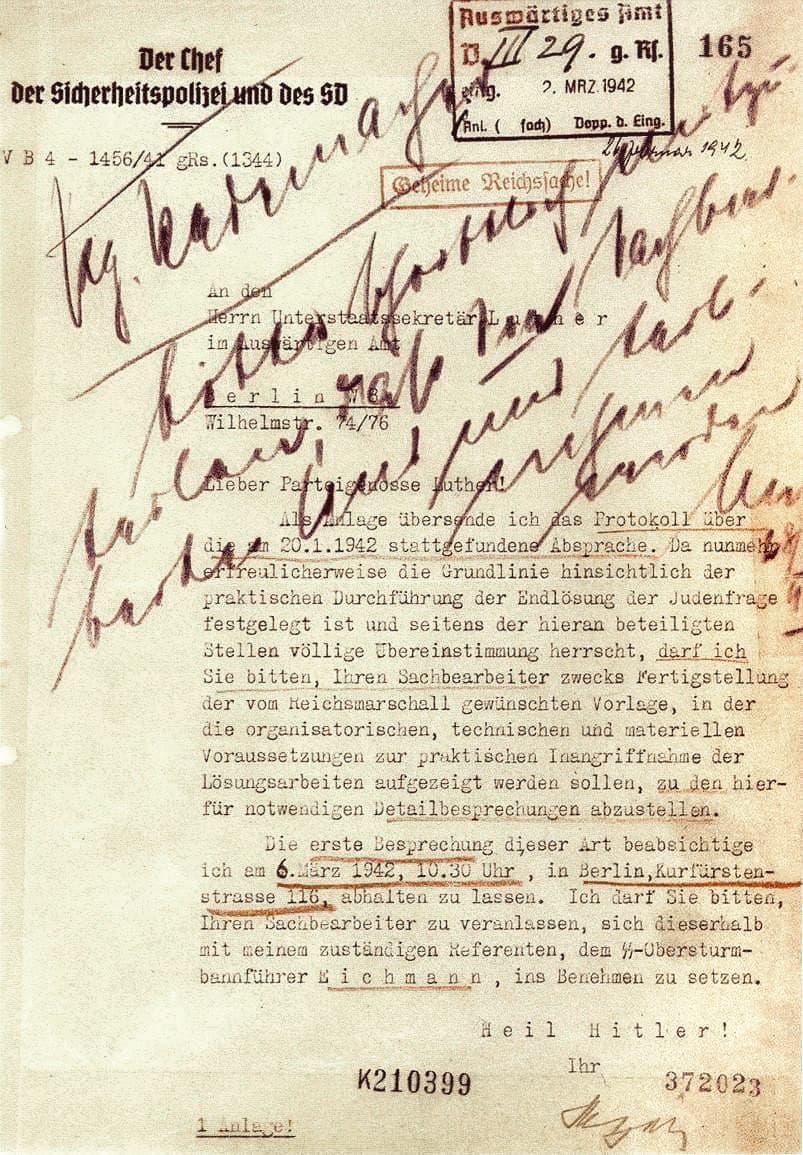
Reinhard Heydrich called the meeting to establish, in front of the state secretaries of the civil ministries, that the SS had authority over what the minutes call the final solution of the Jewish question in Europe, and to settle the administrative questions that would follow.
A coordination meeting
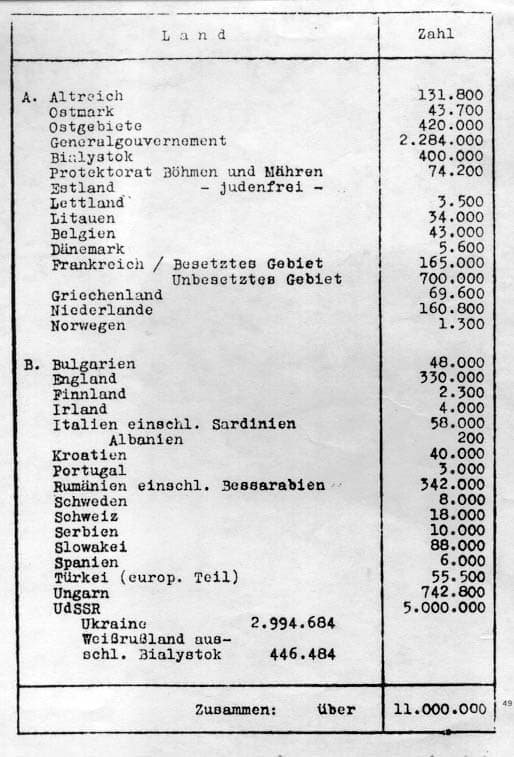
The men in the room were not, for the most part, the people who would carry out the killing. They were senior civil servants — from the Justice Ministry, the Interior Ministry, the Foreign Office, the occupation administrations — whose cooperation was needed for property, citizenship, transport and definitions.
Much of the ninety minutes went on exactly the sort of thing that fills any interdepartmental meeting: jurisdiction, precedence, and a long argument about the treatment of people of mixed descent, which was not resolved and had to be taken up at further meetings.
There was a buffet and brandy afterwards. The banality of the format is the thing that has disturbed every reader of the minutes since.
How the record survived
Thirty numbered copies of the minutes were produced. Adolf Eichmann, who took them, testified that they had been written up in sanitised language on Heydrich's instruction and that the discussion in the room had been considerably plainer than the text.
Copy sixteen was found in 1947 by an American prosecutor going through Foreign Office files that had not been destroyed. Without it the meeting would be a footnote; with it, the coordination of the Holocaust across the German state is documented in a fifteen-page memorandum with a distribution list.
Why it is in this archive
Not because it decided the Holocaust — it did not, and the killing was already under way on a mass scale. It is here because it is the extreme case of something this collection keeps circling: that the most consequential meetings are frequently not the dramatic ones but the administrative ones, and that what survives of them is a matter of chance.
The villa is now a memorial and education centre, and the protocol is on its walls.
What people get wrong
Wannsee did not decide on the extermination of European Jews. That decision had already been taken and implemented — the mass shootings in the occupied Soviet Union had been running since June 1941, and Chełmno had been gassing people since December. Wannsee was a coordination meeting called to assert SS control and secure the cooperation of the ministries. Historians consider this correction important rather than pedantic: treating one meeting as the origin of the Holocaust obscures how many people, over how long, had already made it happen.
Thirty copies were made and twenty-nine were destroyed. What we know rests on the sixteenth.